How To Survive A Bad Baby, Volume I

dinosaur

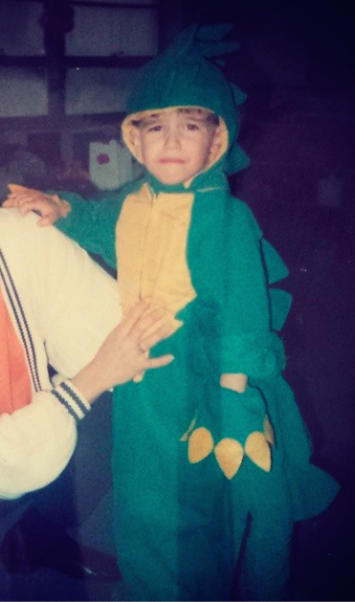
Erin, our first, came along as welcome as a spring rain and as gently as the morning dew. She slept through the night, rarely cried, and gave us a smile when we needed one. Matt, our second, not so much. Among the many long, horrible nights he put us through, one still haunts my fading memory.

I was torn from a deep sleep at 4 a.m. by the blare of a 7-month old mini-siren and the mournful sound of my wife crying. Claire was standing beside the bed holding Matt, who had begun wailing when the obstetrician smacked him on the rear and hadn’t stopped since. Tonight, he was really rocking the house. When he was like this, we both knew the only way to calm him down was to take him for a drive. But I was too exhausted to get behind the wheel, and a co-worker had recently shared a brilliant scheme that she swore always worked with her baby.

I got out of bed, threw on some shorts, staggered out to the Subaru, returned with Matt’s car seat, put it on top of the clothes dryer, put the screaming kid in the car seat, and turned on the dryer. Miraculously, he immediately quieted down. I stared in prideful wonder at the vibrating baby, like Edison at his glowing bulb. Claire gave me a little hug, and we smiled contentedly at each other. Matt instantly saw that for the first time in his life he’d done something to make his parents happy, so he reared back and doubled the previous volume and intensity of his screams. Just then, our long-suffering neighbors in the apartment next door began banging on the wall.

Resigned to my fate, I carried Matt in his car seat to the Subaru and strapped him into the back seat. The tiny car’s acoustics gathered and focused the kid’s screams like a funnel; it felt like he was shrieking inside my skull. I cranked up the AC/DC- to make it a fair fight- and drove aimlessly through the moonlight.

I was dreaming of soundproof rooms and sleeping pills when I dimly perceived a tapping sound growing louder and more insistent. Squinting in the bright sunlight, I slowly woke from a perfect sleep the likes of which I hadn’t known since Matt arrived. A police officer was rapping on the driver’s side window. I quickly turned around to check on Matt; arms and legs splayed out, snoring softly, the little guy was sound asleep. I turned to the officer, put a finger to my lips, made a shushing sound, and rolled down the window.

The cop very softly whispered, “Are you OK?”

“Yeah.”

“Do you know where you are?”

“Uhm.” I had no idea. I looked around, discovered I was in a Whataburger parking lot and, staring straight ahead, answered, “A Whataburger parking lot?” After hearing the whole story, the officer strongly suggested I take Matt home.

Pulling out of the parking lot, I realized I had absolutely no memory whatsoever of pulling into the parking lot: a clear-cut case of sleepdriving.

My sympathies to those dads being driven to sleepless despair by their own mini-sirens. But, if you can resist the natural impulse to head for the hills, in 20 years or so they may, as Matt did, grow into one of the finest people you’ve ever known.
Golf Is A Genetic Disorder

2013-01-01 00.27.24

Heaven knows we can’t help what we love, and my father was helplessly in love with golf. He naturally assumed that his teenage son would be too. But, as much as I liked being with him, I’ve always loathed the game, and it showed in the quality of my play. Of all our misadventures on the links, one lives on in my most vivid nightmares.

For the thousandth time, I stood forlornly over the ball as dad began his tireless litany, “Head down, eye on the ball, left arm straight, hips loose as a goose (then he’d shimmy like Shakira), backswing low and slow, swing through the ball.” It was like driving a car while reading the owner’s manual and resulted in a herky-jerky swing that produced a ball flight consistent only in its absolute unpredictability.

I was just about to hit my drive, when I noticed a course employee had stopped his maintenance cart on the path about 100 yards ahead of us. I waved him on, but he motioned for me to go ahead and hit. My father told me to swing away, there was no way I’d hit him.

Like a dimpled laser beam, the ball’s trajectory varied nary an inch in any direction. The worker dove head-first from the cart, like Pete Rose sliding into second. There was a loud clang as the ball hit the metal fender inches from where he’d been sitting. He quickly got to his feet, yelling and angrily gesturing at me.

I’d fallen to my knees as I’d watched the horror unfolding before me. Dad and I looked at each other in wide-mouthed wonder. I slowly collected myself and said from my knees, “If I’d wanted to hit him, it wouldn’t have gone anywhere near him.” My father, the astonished look still on his face, nodded in mute agreement to the absolute truth of what I’d just said.

Cynics say that parents, like my father, who push children in the direction of their own broken dreams are trying to live through their kids. The truth is, they want their kids’ lives to be perfect. And those childhood dreams of playing centerfield for the Yankees, dancing on Broadway, or playing on the PGA tour are still our ideal of perfection. So, push them we do. I ruined tennis for both my kids when they were little by doing just that.

And then one December day when he was 15, my son, Matt, announced he was going to try out for his high school golf team, despite the fact that he’d never played a round of golf in his life. I went into full parent freak out mode and bought him a specially weighted, caution-tape yellow, training golf club I’d found on the web. When I proudly gave it to him Christmas morning, he looked at it like I’d just handed him a new algebra book.

The next day, I dragged him to a driving range. As he stood forlornly over the ball holding the ridiculous yellow club, I heard myself, as if from a far distance, instructing him, “Head down, eye on the ball, left arm straight, hips loose as a goose (and then I shimmied like Shakira), backswing low and….” I stared out at the horizon for a few seconds, told him I wasn’t feeling well, and walked slowly to the car where I sat and watched him flail happily away at the whole bucket of balls using my old clubs.

To Change A Tire

cars

Like Alice through the looking glass, the real world is disappearing through our computer screens. Work, play, education, shopping, dating, banking, books, letters, and conversations are all vanishing around us; all shoved aside and replaced by their cold, spindly, digital avatars.

And because of the increasing scope and power of the digital world, we’re becoming conditioned to pay more attention to it than to what’s actually happening around us. Just try having a meaningful conversation with someone holding a smartphone. Or try sitting next to them at the movies. This also helps explain why so many of us are suddenly insane enough to text and drive.

This mass migration to the digital frontier is also widening the divide between those of us who pondered the mysteries of building blocks in our playpens and those who surfed the web in theirs. Millenials seem largely unaware that they live in Wonderland, and they appear to prefer it there. That’s why I was almost glad one sunny summer Sunday morning to discover I had a flat tire.

Have you noticed cars don’t break down as often as they used to? Their onboard computers do a much better job keeping things going than the brainless vacuum and gravity fed contraptions of the past. And for reasons probably related to automated manufacturing techniques and computer-aided design, flat tires are also a relative rarity.

As I stared down at the flat, I felt young again. I’d rolled through the 70s on retreads, and every time I was late or on a hot date I’d have a blowout. I got to where I could change one blindfolded. So, here at last was a chance to teach my millennial son one of the hallowed rituals of the pre-digitized world: we’d change a tire together.

He emerged from the house blinking in the analog daylight and in a hurry to reinsert himself back into the matrix. “Where’s the spare?” he asked. I had no idea. We eventually found it, cleverly hidden by the manufacturer underneath the car.
I’d been looking forward to showing him how to work a big old bumper jack, until I noticed the car had no bumper. We eventually found a teeny toy jack, cleverly hidden by the manufacturer behind a seat. But the dinky little crank that turned the teeny toy jack was nowhere to be found.

It was hot outside by now and the siren song of ESPN was calling me back to my recliner. “Where in the world are we going to find a little crank like that?” I whined. My son whipped out his smartphone and, after a few finger swipes, said, “It will be here Tuesday.” So much for my lesson plan.

Two days later, we jacked up the car and unscrewed the lug nuts, but the wheel wouldn’t come off the hub. And each time we yanked on it, the car rocked perilously on the teeny toy jack. Hot and frustrated, my son ran to the garage and came back with a mallet. He proceeded to maniacally whack away at the tire until the wheel broke loose and fell off. I looked at him and smiled proudly: If all the lights ever go out some crazy day, he’ll be fine.